Summary: The atomic age (1945–1965) created a unique cultural anxiety that shaped music, art, and how we process existential threats. From duck-and-cover drills to mushroom cloud tourism, nuclear fear became a creative force, and The Atomic Songbirds channel that same energy into atompunk music about AI and robots.
The Day America Learned to Smile at the Apocalypse
On January 27, 1951, a nuclear bomb was detonated at the Nevada Test Site, sixty-five miles northwest of Las Vegas. The flash was visible from Fremont Street. The ground shook. And within a week, the hotels had added "atomic viewing parties" to their entertainment calendars, right between the dinner show and the midnight burlesque.
That's the atomic age in a single anecdote. Not the fear. The normalization of the fear. The moment an entire culture looked at the most destructive force ever created and said, "Yeah, but can we make a cocktail out of it?"
They could. The "Atomic Cocktail" became a real drink in real bars in a real city that could see mushroom clouds from its rooftops. And the thing is, the people drinking it weren't stupid, and they weren't in denial. They were terrified. They just didn't have anywhere to put the terror. So they put it in a martini glass and kept dancing.
Duck and Cover: Teaching Children to Survive the Unsurvivable
If you want to understand nuclear anxiety as a cultural force, start with the children.
In 1951, the Federal Civil Defense Administration released Duck and Cover, an educational film starring Bert the Turtle. The premise was simple: if you see a bright flash, duck under your desk and cover your head. The film was shown in schools across America for over a decade. Children practiced the drill regularly, crouching under their wooden desks, hands over their necks, eyes shut.
Everyone knew, the teachers, the parents, probably most of the kids, that a school desk would do exactly nothing against a nuclear blast. The drill wasn't about survival. It was about the feeling of having a plan. It gave people something to do with their hands while they contemplated annihilation. And that impulse, creating rituals of control in the face of uncontrollable catastrophe, is the engine that drove the entire atomic age culture.
Backyard bomb shelters followed the same logic. Families spent thousands of dollars on underground concrete rooms stocked with canned goods, water, and board games. Magazines ran articles about shelter decoration. There were debates, heated, genuine debates, about whether it was ethical to shoot your neighbor if they tried to get into your shelter during an attack.
The absurdity is breathtaking. But it was never really about the shelters. It was about the illusion of agency. If you could build something, you could do something. And doing something, anything, was better than sitting with the naked knowledge that you lived in a world that could end before breakfast.
How Music Became the Pressure Valve
Into this atmosphere of smiling dread, music did what music always does: it told the truth that polite conversation couldn't.
The atomic age produced a wave of songs that processed nuclear anxiety through every possible emotional channel: humor, romance, defiance, despair, and a uniquely American brand of cheerful nihilism. If the government's message was "don't worry, we have a plan," music's message was "we all know there is no plan, so let's at least make it swing."
That's exactly the space The Atomic Songbirds live in.
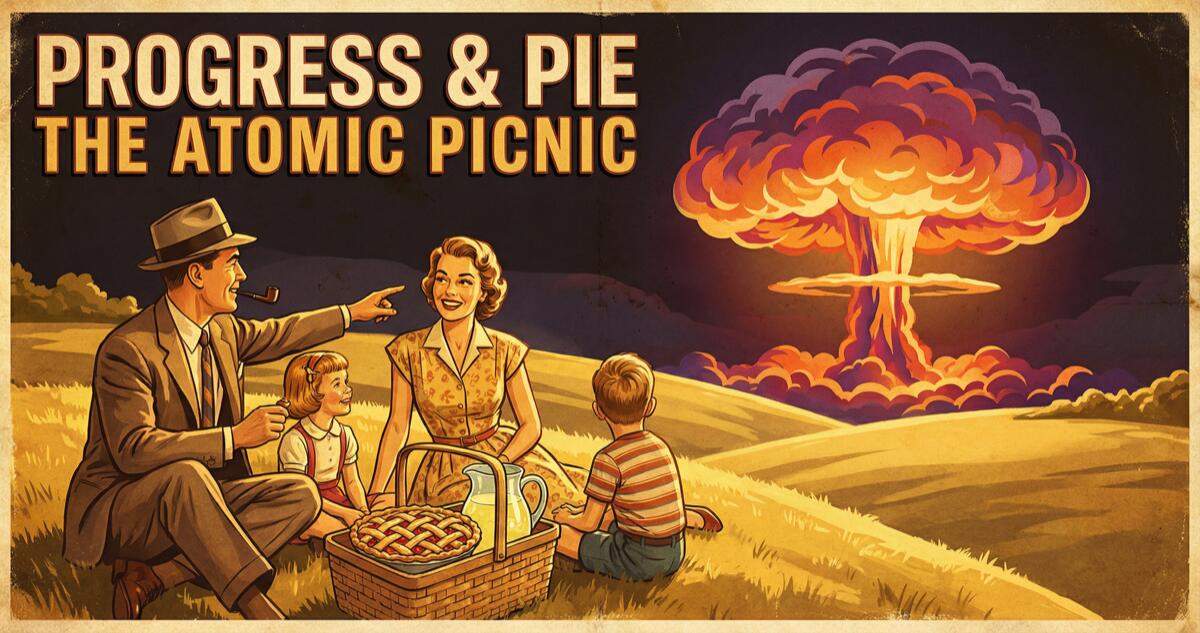
Atomic Sunshine is our darkest song wearing its brightest face. American and Soviet families sit together on a lawn, borscht and burgers side by side, vodka and apple pie, toasting to peace while a mushroom cloud rises on the horizon. This isn't a test they're watching. This is the end, and both sides helped build it. They've normalized their own annihilation so completely that they've turned it into a picnic.
"We're gonna watch a nuke, oh ain't that grand / With our friends and families, hand in hand."
The lyrics are relentlessly cheerful, deliberately joyful, and that's the horror. Not the bomb. The joy. The fact that these people have made peace with mutual destruction and decided to enjoy the show. The genuine, unforced happiness of people who had accepted annihilation as background noise and decided to enjoy the show.
Shelter Romance and the Intimacy of Doom
While "Atomic Sunshine" captures the public spectacle, Shelter of Love captures what happened behind closed (blast-proof) doors.
The bomb shelter was one of the strangest spaces in American domestic life. It was a room designed for the end of the world, and people filled it with the comforts of the world that was ending: canned soup, family photos, transistor radios. And in that sealed, underground space, something unexpected happened: intimacy.
"The sirens wail, the bombs may fall / But here with you, I'm safe through it all."
There's a psychological truth buried in "Shelter of Love" that goes beyond the Cold War. When the external world becomes maximally threatening, the internal world, the space between two people, becomes maximally precious. Bomb shelter love isn't love despite the apocalypse. It's love because of it. The threat of total destruction strips away everything trivial and leaves only the question: who do you want beside you when the ceiling shakes?
Shelter manufacturers understood this instinctively. They marketed to newlyweds. They ran ads showing young couples holding hands in well-lit underground rooms. The bomb shelter wasn't just a survival tool. It was a love nest for the end times.
Laughing at the Bomb: Satire as Survival
And then there's the other response to nuclear anxiety: laughing directly in its face.
Bite My Bomb is Cold War satire at full volume. It takes the entire US-Soviet nuclear standoff, the posturing, the missile counts, the brinksmanship that could have ended civilization, and turns it into a jazz number. The superpowers aren't locked in a deadly struggle for global dominance. They're in a dance-off. And they both look ridiculous.
"Bite my bomb, baby, don't you see / I got missiles in my pocket, you got some for me."
The lyrics deliberately dissolve into absurdity at their most intense moments, because when the subject matter is mutually assured destruction, language itself becomes inadequate. What words could possibly be adequate? Better to abandon them entirely and let the ridiculousness speak for itself.
Humor was the atomic age's most subversive coping mechanism. The government wanted solemn preparedness. Satirists offered gleeful mockery. And the mockery was more honest, because it acknowledged what the official line couldn't: this situation is insane, we know it's insane, and pretending otherwise is the most insane part.
Escape Velocity: When the Only Option Is Leaving
Glow, Baby, Glow! takes the nuclear anxiety narrative to its logical extreme: if you can't stop the bombs, leave the planet.
The song intertwines personal heartbreak with global catastrophe: a woman whose boyfriend cheated and whose world is literally ending decides to hop on a rocket and get out. The bombs and the breakup become indistinguishable. Both are explosions. Both end a world.
"Atoms split, he split, guess we're all splitsville now."
What I find fascinating about "Glow, Baby, Glow!" is the optimism embedded in the escape. The space race was running parallel to the arms race throughout the Cold War, and they drew from the same well of atomic-age energy. The same rockets that could deliver warheads could also deliver humans to the stars. Destruction and salvation, launched from the same pad.
That duality, the bomb and the rocket, the end and the beginning, is the atomic age's most lasting legacy.
The Anxiety That Never Left: From Nuclear to Digital
Here's the thing I keep coming back to: nuclear anxiety didn't end. It just changed shape.
In the 1950s, people worried about a technology they'd created but couldn't fully control: a force that could destroy civilization if the wrong person pushed the wrong button. They coped with humor, ritual, and a stubborn insistence on normalcy. They built shelters and had picnics and taught their children to duck under desks.
In the 2020s, we're doing exactly the same thing with artificial intelligence. We've created something powerful, potentially transformative, and possibly dangerous. We don't fully understand it. We can't fully control it. And we're processing our anxiety about it through memes, jokes, and a curious blend of excitement and dread that would have felt very familiar to someone watching a mushroom cloud from a Las Vegas rooftop in 1953.
The parallels are almost too neat. Duck-and-cover drills taught children the illusion of control; AI safety guidelines teach organizations the illusion of governance. Backyard bomb shelters gave families a project to channel their fear; "AI ethics boards" give corporations the same thing. And just as the atomic age produced a culture that was simultaneously terrified and entertained by its own potential destruction, we scroll past headlines about existential AI risk and then ask ChatGPT to write us a poem about our cat.
We're at the atomic picnic again. Different blanket, same mushroom cloud.
Why Atompunk Gets This Right
This is why atompunk, as a genre, as an aesthetic, as a way of seeing the world, is the perfect vehicle for these stories. Atompunk doesn't pretend the anxiety isn't there. It doesn't rationalize it away or bury it under techno-optimism. Instead, it puts the anxiety in a sharkskin suit, hands it a saxophone, and lets it swing.
The Atomic Songbirds exist in a world where nuclear bombs and sentient robots showed up at the same party. The joy and the terror are inseparable. The music is catchy because the subject matter is catastrophic. And the combination, toe-tapping songs about the end of everything, turns out to be the most honest response to existential threat that art can offer.
Because the alternative is silence. And silence never saved anyone.
So put on your sunglasses. Open the picnic basket. The sky is glowing, the band is playing, and the anxiety isn't going anywhere.
Might as well dance.