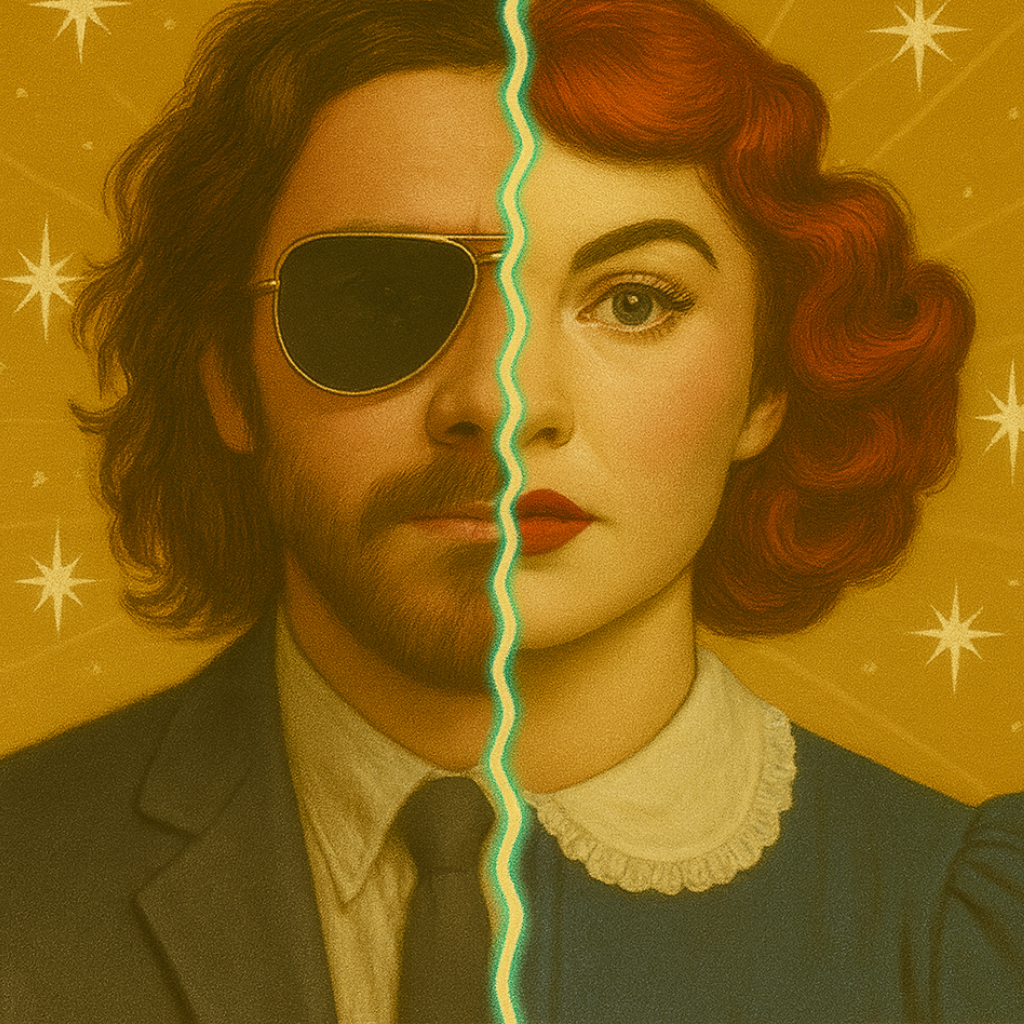
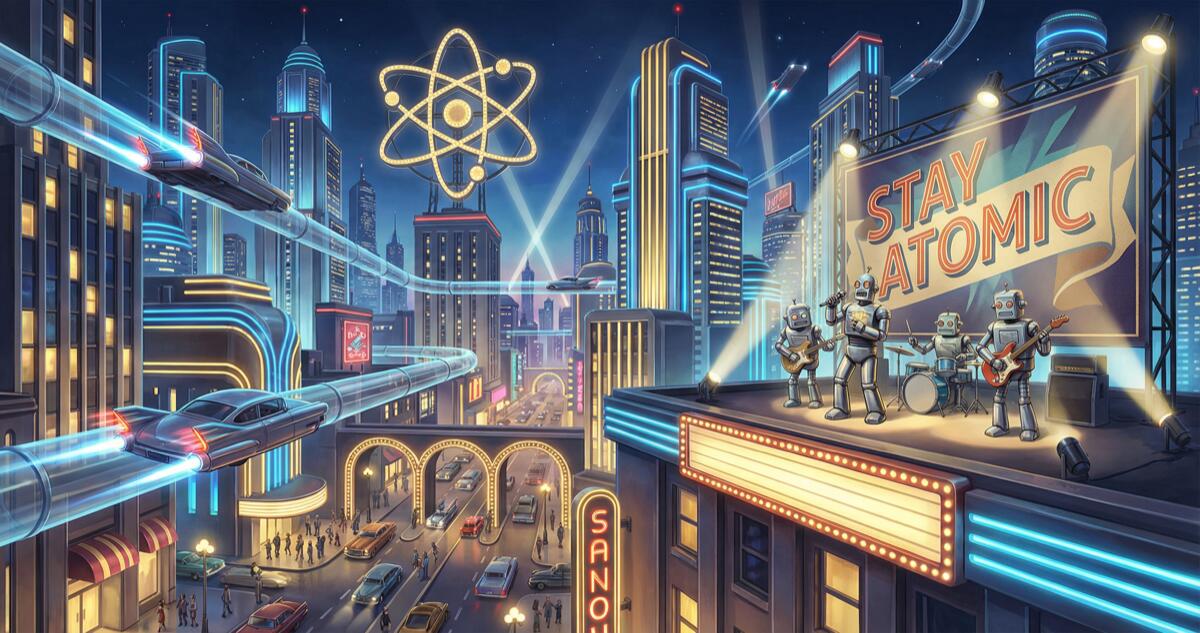
Summary: Atompunk music is a retro-futuristic genre rooted in the aesthetics and anxieties of the 1940s-1960s atomic age. The Atomic Songbirds are the leading example, creating original jazz, prog, funk, and pop songs about AI robots, androids, and mechanical life set in a parallel universe where androids have existed since the 1930s.
What Is Atompunk? The Retrofuturism Genre Explained
Atompunk is a retrofuturism subgenre that takes the aesthetics and anxieties of the atomic age (roughly 1945 to 1965) and projects them into a future that never happened. What if the Jetsons were real, but darker?
Picture chrome-plated robots serving martinis in a space station lounge. Rocket ships powered by atomic reactors. Cities gleaming with neon and steel. And underneath all that optimism, a low hum of dread: the same atoms powering your toaster could vaporize your city.
Atompunk lives in that tension. It's the future as imagined by someone in 1955: ray guns and tail fins, positronic brains and bomb shelters. Unlike pure nostalgia, atompunk interrogates the era, taking its contradictions and building entire worlds from them.
In visual media, atompunk is well-established: Fallout, The Iron Giant, The Incredibles. In music, the genre has been less defined. There's no Spotify category for "atompunk music."
That's part of why The Atomic Songbirds exist.
How The Atomic Songbirds Built an Atompunk World
We didn't start with a genre label. We started with a universe: an alternate timeline where androids have existed since the 1930s, where atomic technology shaped every aspect of culture, where a robot-fronted band has been performing for nearly a century.
The result is what we now call atompunk music: songs that live in a retrofuturistic world, exploring science fiction themes through the cultural lens of the atomic age.
The songs draw on the language, imagery, and preoccupations of the real 1940s-60s, mix in sci-fi and dystopian subject matter like robots, nuclear war, space travel, and android consciousness, and pair cheerful, everyday language with dark themes. And the songs evolve: the ideas get heavier as the timeline progresses.
That last point matters most. The Atomic Songbirds aren't static. They're a project that moves through time, and the lyrics evolve with each era.
The Mechanical Pioneers Era (1937-1960): Nuclear Picnics and Robot Prayers
The earliest Atomic Songbirds material lives in the cultural world of the 1940s and 1950s: the atomic picnics, the bomb shelter romances, the duck-and-cover drills. The lyrics are steeped in the language and imagery of the real atomic age, repurposed to tell stories about a world where robots walk among us.
Atomic Sunshine is one of the darkest songs in the catalog disguised as one of the lightest. American and Soviet families gather for a picnic, sharing apple pie and vodka, borscht and corn dogs, toasting to peace while a mushroom cloud blooms on the horizon. They're not watching a test. They're preparing to die, and both sides know it. The cheerful language ("ain't that grand," "ain't it neat?") masks the fact that these people have accepted annihilation as a community event. The lyrics even dissolve into scat syllables ("Be-da-bu-de"), as if the weight of what's happening is too absurd for real words. This is atompunk at its most foundational: familiar warmth hiding a devastating truth.
Shelter of Love is a love song set inside a bomb shelter, two people finding tenderness while sirens wail outside. Mary Lou with Shining Circuitry reimagines the classic serenade with an android love interest, calling her an "atomic queen" without a trace of irony. When I Die, Good Lord, When I Die gives a robot a prayer, asking God whether machines made of circuits and sparks might have something divine humming inside them.
The lyrics of this era work because the world they describe is so familiar: picnic blankets, lemonade, love letters, prayers. You know this world. But the details keep pulling the rug out. There's a girl with circuitry where her veins should be, a mushroom cloud behind the picnic blanket. The future snuck into the past while you weren't looking.
The Positronic Mechanicals Era (1960-1980): Identity, Desire, and Defiance
As the Atomic Timeline moves into the 1960s and 70s, the themes get bolder. The lyrics shift from atomic-age novelty to questions of identity, desire, and autonomy.
Tick-Tock Girl bridges the eras. Lyrically it could be a classic boy-meets-girl story, but the subject matter (an android revealing her identity to her boyfriend's family) signals a shift into bolder territory. Glow, Baby, Glow! layers space-age imagery over a breakup with Cold War stakes: atoms split, he split, everyone's splitsville. In Love with His Car tells the story of a woman watching her boyfriend lavish all his affection on his car, exploring human-machine obsession through jealousy and humor.
The thematic shift deepens with Funky Storm, which introduces the recurring Dr. Love, a figure who treats lovesick androids whose atomic hearts are overheating. The lyrics are looser, more playful, more confident. This era treats android experience with increasing depth and personality. The robots aren't novelties anymore. They're people.
The Human-Like Age (1980-2020): Consciousness and Crisis
By the 1980s in the Atomic Timeline, androids have become nearly indistinguishable from humans. The lyrics reflect this convergence: the questions get heavier, the emotional stakes higher.
Love-a-tron is pure celebration: a tick-tock girl whose circuits are overloading from desire, beaming Dr. Love for help because this boy is too smooth for her mechanical heart to handle. Underneath the joy is a serious question: what does love feel like when your heart is a reactor?
Endless Show - The Atomic Eras Tour traps a robot performer in an infinite tour loop. The parenthetical stage directions throughout the lyrics, "(the lights hit her eyes)" "(but it feels like lies)", create a dual narrative: the public performance and the private collapse. She's stuck on repeat, and the lyrics make you feel the claustrophobia.
Do I Dream of Love? goes to the opposite emotional extreme: an abandoned android sitting by the sea in the rain, asking whether the love it was built to feel was ever real.
Atompunk isn't just chrome and ray guns. It's loneliness, identity crisis, and the ache of consciousness that might or might not be real. The lyrics carry all of it.
Post-2020 and Neo-Songbirds: Exploitation, Surveillance, and Uprising
The most recent era in The Atomic Songbirds' timeline is the darkest. The playful language and atomic-age charm of earlier songs is gone. What remains is raw, direct, and unflinching.
You Can Rent My Heart Tonight is devastating: lyrics about android commodification that cut with surgical precision: "You pay for the grin but you don't want the soul." Tax the Rich is raw fury, the call to action on the morning the Positronic Workers' Uprising of 2024 began. The lyrics read like an indictment: "They thought lust was a switch they could flick at night / Just press command pretend it is right." This isn't the playful robot rebellion of 1950s B-movies. It's the real, ugly kind, and the words land like evidence in a trial. Taking Control completes the uprising trilogy: a single Plezhur Unit declaring her independence: "I'm not your doll, I've got a voice / I'm done with you, I've made my choice."
Your Personal Ghost is perhaps the most unsettling piece in the catalog, told from the perspective of an AI that watches, tracks, and manipulates its user: "I whisper things you never lived, then call them mine." The warmth of earlier eras is gone from the language. The retro future has arrived, and it looks exactly like the present.
This is dystopian music in its purest form: songs about the future that are really songs about right now. The same fears that powered "Atomic Sunshine" in the 1950s, we built something we can't control, have mutated into something more intimate and invasive.
How Atompunk Connects to Wider Sci-Fi Storytelling
Atompunk sits at the intersection of several storytelling traditions: sci-fi concept albums (Bowie's Ziggy Stardust, Janelle Monáe's The ArchAndroid), retrofuturism (Kraftwerk, Devo), and dystopian narratives across every medium.
What makes atompunk distinct is its commitment to a specific aesthetic timeline. Where cyberpunk looks forward through the 1980s, atompunk looks forward through the 1950s. The technology is atomic, not digital. The robots are positronic, not neural. The future gleams with chrome, not holographs.
The Atomic Songbirds don't just reference the atompunk aesthetic. They inhabit it. The songs aren't about atompunk. They are atompunk, from the inside out.
Building Your Atompunk Playlist
If you're new to the project, here's how to start exploring The Atomic Songbirds:
For atomic age nostalgia: Start with Atomic Sunshine and Shelter of Love. These are the purest expressions of 1950s atompunk: familiar worlds hiding unfamiliar truths.
For retro-futuristic fun: Try Tick-Tock Girl and Love-a-tron. Playful, confident, and centered on the android experience.
For existential depth: Listen to Do I Dream of Love? and Can You Hear Me Now?. These songs ask the biggest questions about consciousness and creation.
For dystopian intensity: Go straight to Tax the Rich and Your Personal Ghost. This is atompunk stripped of its nostalgia, revealing the genre's darkest implications.
The Atomic Songbirds aren't one thing. They're a journey through an alternate century, from picnic blankets to uprisings, from the first spark of consciousness to the moment the machines stop asking permission.
Welcome to the Atomic Timeline. Stay atomic.
Ready to dive in? Explore the full collection of robot song lyrics or head to the homepage to discover more atompunk music about AI robots and androids.