
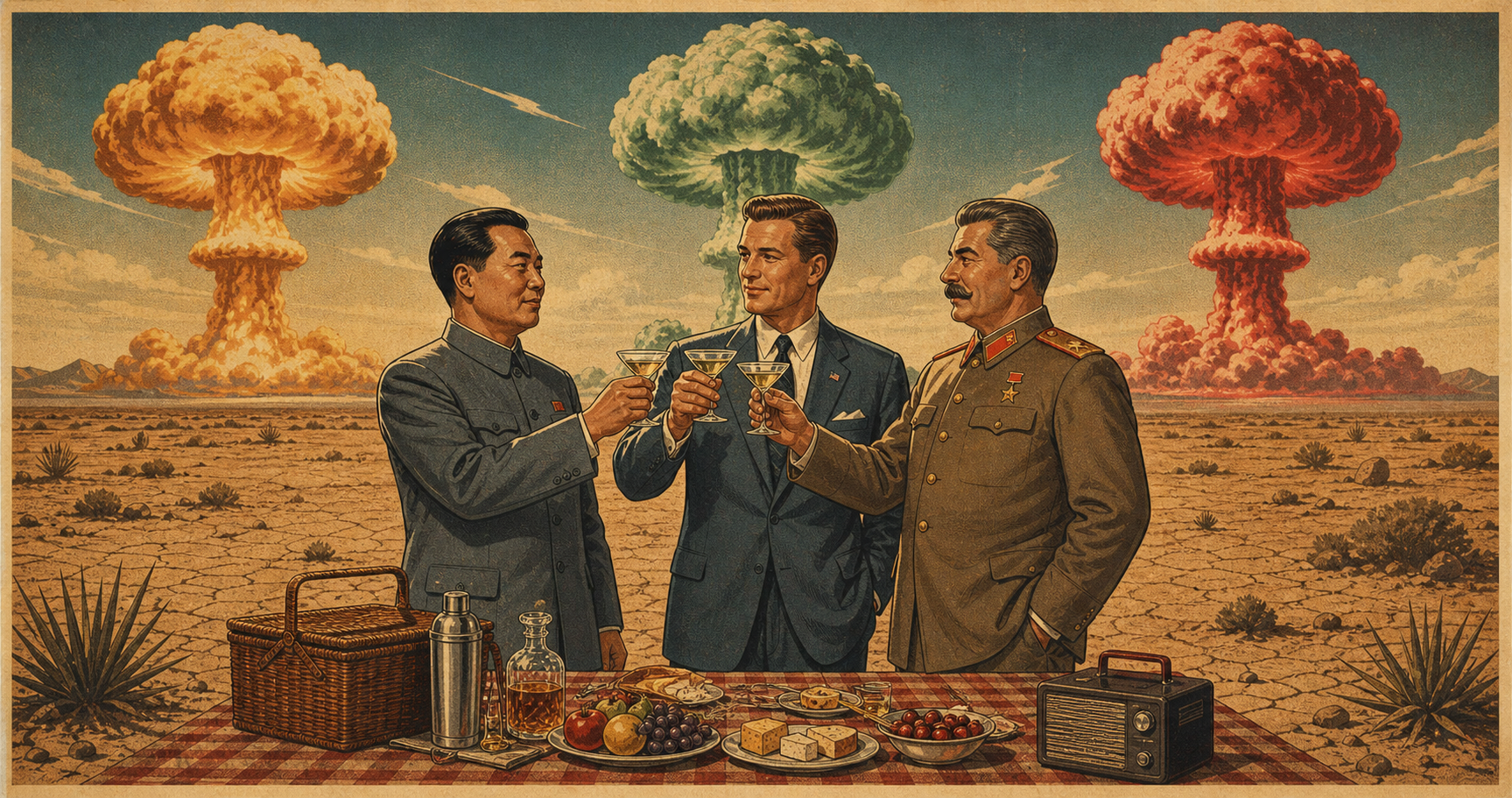
Summary: The Cold War was a bilateral standoff. Today's nuclear landscape is a three-way tension between the USA, Russia, and China, with modernizing arsenals, collapsing arms treaties, and proxy conflicts bleeding into open confrontation. The Atomic Songbirds have been singing about this world since 1939. The picnic blanket is back out.
The Two-Player Game Is Over
Here is what the original Cold War had going for it: clarity. Two superpowers, two arsenals, two sets of launch codes. Mutually assured destruction worked, in its grotesque way, because both sides understood the rules. You pushed; I pushed back. We both stopped at the edge. The whole structure was terrifying but legible.
That structure is gone.
The nuclear world we now inhabit has three major players (the United States, Russia, and China), none of whom are operating under the same arms-control frameworks that kept the original standoff from going hot. The last major US-Russia treaty limiting strategic nuclear weapons, New START, expired in February 2026 with no successor. China, which was never party to bilateral US-Russia agreements, has spent the past decade expanding its nuclear arsenal at a pace that American analysts describe, with remarkable understatement, as "significant." Russia, under sustained sanctions and international isolation following the Ukraine war, has made nuclear signaling a routine diplomatic tool. American defense spending on nuclear modernization is at its highest since the Cold War.
We are not in a Cold War. We are in something new, without a name yet, and the rules are being written in real time.
"Atomic Sunshine" Was Always About Now
When we wrote Atomic Sunshine, we set it in 1950: American and Soviet families gathered for a joint picnic beneath a mushroom cloud, both sides having built the catastrophe together, both choosing to celebrate rather than grieve. It was a song about denial. About how humans normalize the unthinkable when they've had enough time to get used to it.
"We'll dance in the glow, of that atomic ray / In our perfect world, it's a brand new day!"
That was supposed to be a period piece. A love letter to a specific Cold War absurdity: the Miss Atomic Bomb pageants, the nuclear-themed cocktail menus, the families who drove their kids out to the Nevada desert to watch a test blast and called it a vacation.
But here we are, seventy-odd years later, and the same picnic is being set up again. Defense think tanks publish lengthy analyses of China's silo expansion programs alongside weekend forecasts. US and Russian strategic bombers conduct incursions that require official diplomatic objections, then everyone goes to lunch. The vocabulary of nuclear brinksmanship ("escalation dominance," "tactical nuclear options," "credible deterrence") has re-entered mainstream foreign policy coverage as though it never left.
The picnic is still happening. The blanket just has three families on it now.
The Third Player Changes Everything
The original MAD framework was a bilateral equation. Adding a third major nuclear power doesn't just complicate the math. It breaks the structure entirely.
Consider: arms control treaties have historically been bilateral. The US and Russia spent decades negotiating mutual limits on warhead counts, delivery systems, and deployment postures. China sat outside those negotiations. Now, as China's arsenal approaches numbers that make it a genuine peer competitor rather than a regional power, the US faces a genuine strategic dilemma: does it limit its arsenal in negotiations with Russia while China expands, or does it walk away from arms control entirely and modernize to maintain a two-front deterrent?
Neither option is comfortable. Both have been tried.
Russia, meanwhile, has demonstrated in Ukraine that nuclear signaling can be used as a shield for conventional aggression: the implicit threat of escalation creates a buffer zone in which military action can proceed without direct great-power response. This is not a new observation. What is new is that it has been stress-tested on European soil for three years and the buffer has held.
China is watching. So is everyone else.
"Bite My Bomb" and the Logic of Posturing
Bite My Bomb was written as satire: a jazzy takedown of nuclear brinkmanship that turns Stalin and FDR into two guys in a dance-off, daring each other to light the fuse.
"Bite my bomb, baby, don't you see / I got missiles in my pocket, you got some for me."
The joke worked because the underlying dynamic was real: nuclear powers have always used their arsenals primarily as instruments of political signaling rather than instruments of actual war. The bomb is most powerful as a threat. The moment you use it, you've both lost.
But "Bite My Bomb" was written for two players. The three-player version of this game is structurally different. In a bilateral standoff, your deterrent is aimed at one adversary and your signaling is read by one audience. In a trilateral standoff, your posture toward one adversary is simultaneously a signal to a third party who may read it differently.
When the US declares it will defend Taiwan against Chinese military action, it is signaling to Beijing, but it is also signaling to Moscow, telling Russia something about American willingness to commit forces while its attention is split. When Russia threatens nuclear use in the Ukraine context, it is signaling to NATO, but it is also telling China something about Russia's perceived weakness and desperation. Each bilateral signal is a multilateral message, and the interpretive gaps between intended meaning and received meaning are where accidents happen.
This is not a scenario the original Cold War's two-player framework was designed to handle.
The Arsenal Numbers
Let's be specific, because the abstract phrase "modernizing arsenals" does not convey the actual scale of what is happening.
Russia maintains approximately 5,580 nuclear warheads, of which around 1,700 are deployed on strategic systems. The United States holds approximately 5,044 warheads, with around 1,670 deployed. China's arsenal, long estimated at a few hundred weapons, has been expanding rapidly. Current estimates range from 500 to over 600 warheads, with projections suggesting China could reach 1,000 by 2030 and 1,500 by 2035. These are moving targets; the satellite imagery that underpins these estimates shows construction at a pace that has surprised even pessimistic analysts.
New START's expiration means there is currently no formal limit on how many strategic weapons the US and Russia can deploy against each other. Talks on a successor framework have not produced results. The arms-control architecture that took decades to build has, over the past decade, been methodically dismantled: the INF Treaty (withdrawn by the US in 2019), Open Skies (withdrawn by the US in 2020, Russia in 2021), New START (expired 2026). What remains is the Non-Proliferation Treaty, a framework designed for a world that no longer exists.
Where The Atomic Songbirds Lived
The in-universe history of The Atomic Songbirds is, at its core, an alternative history about what happens when the Cold War ends differently. Frank Evans sent his robots to Stalin in 1940; the Tekhnosoyuz détente followed; the arms race was redirected into a competition of technological artistry rather than mutual annihilation.
That didn't happen in our timeline.
What happened in our timeline is that the Cold War ended, and then didn't end. The nuclear arsenals never went away. The treaties that constrained them eroded. The mutual suspicion that animated them shifted rather than dissolved. And now, with a new configuration of great-power competition that the old framework wasn't designed to accommodate, we find ourselves back at a version of the same ledge, with better graphics.
The songs we wrote about atomic anxiety were not nostalgic exercises. They were observations about a recurring human pattern: we build the thing that can kill us, we normalize living next to it, and we call that civilization.
The Picnic Has Three Tables Now
What is different this time is not the fear. The fear is the same. What is different is the structure of the problem.
The original Cold War was terrifying, but it was bilaterally terrifying: two parties, each with a clear interest in the other party's continued existence as the only alternative to mutual annihilation. That shared interest in each other's survival was the dark foundation of strategic stability. Neither side wanted to "win" in a way that required the other side to cease to exist, because ceasing to exist was the outcome both sides were trying to avoid.
A three-player version of this game does not have that clean bilateral symmetry. Three parties can form two-against-one configurations. One party might calculate that the other two destroying each other is an acceptable outcome. The stability assumptions that made deterrence work for seventy years are structural, not moral, and the structure has changed.
Atomic Sunshine ends with a toast to peace under the mushroom cloud. It's a joke about resignation. About a culture that looked at the bomb and decided the only response was to go ahead and have a nice time anyway.
Three families on the picnic blanket is not a more stable arrangement. It's just a stranger one.
The sky is the same. The sandwiches are the same. And somewhere, a brass section is warming up.
Atomic sunshine, ain't it neat.